Quebec: Vanguard of Secularism in North America

Free Inquiry

2026-02-13

The article Quebec: Vanguard of Secularism in North America is published on the website of the American freethought magazine Free Inquiry, published by the Center for Inquiry (CFI) in the USA. A few excerpts from the article are shown below.

Sommaire en français Ce texte, « Le Québec, à l’avant-garde en matière de laïcité en Amérique du Nord » est paru sur le site web de la revue américaine Free Inquiry, une publication du Center for Inquiry (CFI) aux États-Unis. En voici quelques extraits.

[…]

On June 16, 2019, Quebec adopted Bill 21, Loi sur la laïcité de l’État or An Act respecting the laicity of the State. The word “laicity” is a dubious translation from the French “laïcité” and should arguably be replaced by the more familiar English term secularism. Nevertheless, the use of that term in this legislation is a reminder that Quebec takes its cue from France, where secularism necessarily includes the principle of separation between religion and state, not merely religious neutrality. Whereas in the English-speaking world, the separation principle tends to be given only lip service.

[…]

Another law, Bill 9 or An Act respecting the reinforcement of laicity in Québec, was proposed by the Quebec government on November 27. This bill would implement several of the Pelchat-Rousseau Committee’s recommendations. […] Unfortunately, Bill 9 as proposed, Bill 94 as adopted, and Bill 21 as adopted some six years previously, contain no provision to curtail the fiscal privileges currently granted to religious institutions. Furthermore, all three contain a so-called “grandfather” clause that allows an exemption from the religious symbol ban for employees on staff when the law was first proposed. Thus, much remains to be done. Nevertheless, each of these bills constitutes a major step forward.

While Quebec makes steady progress toward secularism, Canada at the federal level stagnates as a soft theocracy (to borrow an expression from Australian secularist Max Wallace). Canada’s head of state is King Charles III, also titular head of the Church of England. The very first line of the Constitution Act of 1982 (which is also the first line of the much-overrated Canadian Charter of Rights and Freedoms) declares that “Canada is founded upon principles that recognize the supremacy of God and the rule of law.” (Note also the oxymoronic nature of that declaration.)

[…]

Federal Canadian legislation is riddled with religious privileges, probably the most egregious being the religious exception (paragraphs 319(3)b and 319(3.1)), in the Hate Propaganda section of the Criminal Code, which grants immunity to religious speech.

[…]

Support for and opposition to Bill 21 are almost perfectly aligned with linguistic differences. Secularism enjoys overwhelming support from the Quebec population. Secular organizations in Quebec are unanimous in their support. But in Canada outside Quebec, the opposition from politicians and media is ferocious, often expressed in extreme language containing elements of anti-Québécois ethnic bigotry. Nevertheless, even in English Canada, popular opinion does not necessarily agree with the knee-jerk opposition so obvious among political and media elites.

[…]

See also:


Next blog: Supreme Court Must Respect Quebec’s Democratic Choice of Bill 21

Framing the Religious Symbol Debate

The Question is Not IF but Rather WHERE

2025-12-28

Separation between religions and State requires banning religious symbols worn on the job by at least some civil servants and school personnel. Thus, the question for secularists is not whether to ban, but rather where, in what contexts, bans are necessary to protect freedom of conscience.

Sommaire en français La séparation des religions et de l’État nécessite l’interdiction du port de signes religieux au travail par au moins certains fonctionnaires et membres du personnel scolaire. Ainsi, pour les laïques, la question n’est pas de savoir si, oui ou non, il faut interdire, mais plutôt où et dans quels contextes une telle interdiction est nécessaire pour protéger la liberté de conscience.

This article sets forth how the debate about secularism should, in my opinion, be framed, i.e. the context in which the debate should occur. I am thinking in particular of the ban on religious symbols worn by civil servants and teachers while on duty. By “the debate” I do not mean the disagreement between those who support such bans and those who oppose them. No, I mean the disagreement between (1) those who are of the opinion that secularists may agree or disagree with such bans, and (2) those who affirm that secularists must necessarily support such bans, at least in some circumstances, but may differ in the details. It is this latter disagreement which must be addressed by the debate.

If you are familiar with my previous writing about these issues, then you already know that I favour the approach (2) and reject (1). Here, I will explain why it is important to frame the debate in this way.

One of the core principles of secularism is the separation between religions and State, i.e. taking whatever measures are reasonably necessary to prevent religious interference with the affairs of the State, such as legislation, civil services and public education. In order to prevent State employees from engaging in proselytism, whether active or passive, it is necessary (but not sufficient) to ban such employees from wearing political, religious or commercial symbols while on duty. Just as we would not want a judge or schoolteacher to wear a partisan political symbol while on duty, we must have similar objections to conspicuous crucifixes, hijabs or other religious emblems worn on the employee’s person.

Varieties of Proselytism

Proselytism includes a variety of behaviours ranging from directly trying to recruit others to join one’s religion, to imposing one’s religion on others, to simply advertising it. It may occur within a single religion, i.e. the target may be of the same religion as the proselytizer. One obvious example is a pious Muslim trying to convince a less devout Muslim woman that she should wear the veil in order to be a “good” Muslim.

Proselytism…may occur within a single religion, i.e. the target may be of the same religion as the proselytizer.

When the person doing the advertising (or imposing or attempting to convert) is an agent of the State, especially if they are in a position of authority, then that person is using their status and authority to influence others. It is a form of religious interference in State affairs. This is especially serious if the person deals with children who are particularly vulnerable to indoctrination. This is not difficult to understand. It is obvious to anyone who supports the principle of separation between religion and State.

To remove religious symbols while working for the State is a small and reasonable restriction on religious practice—but which has no effect on religious belief. It is a mere inconvenience for the person involved (no matter how loudly they may whine), but has a major benefit for everyone: the absence of religious partisanship and of proselytizing in civil services.

No, We Cannot Agree to Disagree

Thus, if one espouses secularism, one must necessarily accept the notion that banning religious symbols for at least some State employees is the appropriate thing to do. Secularists may disagree on secondary questions. For example, should such bans apply to all civil servants, or only to those who are in regular contact with the public, or only to those in positions of authority? Should sitting members of a legislative assembly be exempted from such bans because they are primarily elected representatives and not considered to be agents of the State?

[…] to oppose all bans on religious symbols in all situations is an extremist, anti-secular position, leaving the door wide open to abuse.

However, to oppose all bans on religious symbols in all situations is an extremist, anti-secular position, leaving the door wide open to abuse. Not only is the principle of separation thus violated, but the freedom of conscience of schoolchildren and civil service users is undermined by allowing school personnel and State employees to advertise their religion (or their political convictions) on the job.

Thus, any person or organization claiming to support secularism but opposing all religious symbol bans is not only anti-secular, but also hypocritical, flagrantly betraying the very secularism they purport to uphold. Neutrality regarding such bans is not a valid option either, because it constitutes a cowardly failure to do the right thing, a failure to protect the freedom of conscience of the citizenry from religious proselytism.

The Urgent Situation in Quebec and Canada

Currently, a legal challenge to Quebec’s Bill 21, which bans religious symbols for some State employees and declares that all persons have a right to secular institutions and public services, is upcoming in the Supreme Court of Canada. The list of organizations and individuals attacking the Bill, some religious but certainly not all, is long and disturbing, indicating just how deep and widespread is the ideological capture of various institutions in our society. Particularly disturbing is the influence which political Islam has already achieved.

If political Islam were not an issue, legislation such as Bill 21 would still be necessary, although less urgent. However, the situation is indeed urgent. All religions are potentially dangerous, while the three Abrahamic religions—Judaism, Christianity and Islam—are particularly toxic. Islam in particular, if applied fully, promotes several brutal practices such as criminalization of apostasy and homosexuality, with severe penalties, as well as the denigration of women. In North America, Muslims represent a small minority while Islamists represent a minority among Muslims, Nevertheless, Islamists have enormous influence in Canada, far beyond what one would expect given their small numbers. The reason for this is obvious: they have many allies among non-Muslims, even among atheists, many of whom have become enthralled by various identitarian ideologies which promote cultural relativism and strongly emphasize personal identities to the detriment of universal human rights.

Accusations of “Islamophobia” function as a de facto prohibition on blasphemy against one particular religion.

A particularly egregious example of this alliance is the Canadian government’s appointment of a “special representative on combatting Islamophobia” whose evident task is to promote religious privileges for Islam. Accusations of “Islamophobia” function as a de facto prohibition on blasphemy against one particular religion. The situation in Europe is worse than in North America, but it is only a matter of time before the influence of political Islam becomes a serious threat to our quality of life.

The non-Muslim allies and facilitators of Islamism remain complacent, wilfully blind to the various strategies of political Islam. The game plan includes promotion of the veil, specious accusations of “Islamophobia” in order to silence critics, proliferation of halal products, playing the victim and the use of the concept of human rights as a weapon against human rights. One example of this last strategy is the use of false accusations of “discrimination” thrown against secular legislation such as Bill 21. Another is the racialization and essentialization of religious affiliation (a process which negates freedom of conscience) in order to denigrate secular legislation with bizarre accusations of “racism.”

Who is Doing the Discrimination?

The accusation that Bill 21 “discriminates” against anyone is patently false. The legislation applies to all persons, regardless of sex, regardless of religious affiliation or lack thereof. To accuse Bill 21 of discrimination (whether against women, or against Muslims or against any other group) is like accusing anti-theft laws of discrimination against thieves, or accusing speed limits of discrimination against owners of fast cars. A person who wears a religious symbol and who refuses to remove it, even at work, even in the civil service or a public school, is either a fanatic or an unwitting agent of fanatics who are using that person to advance their politico-religious agenda. It is misogynistic religions which discriminate against women, while secular legislation does precisely the opposite, discouraging displays of the symbols of such misogyny.

Secularism…must also protect the religious believer from their own community, allowing the individual to set their own course in life […]

I have insisted on religion-State separation as an essential principle of secularism. Another major principle is freedom of conscience. The purpose of the former is to protect the latter. Secularism must of course protect the individual from the undue imposition of other religions or convictions. But it must also protect the religious believer from their own community, allowing the individual to set their own course in life, either as a member of that group, or not, as they choose. Similarly, secularism must protect children from the religion of their family, offering a universalist education and vision of the world, so that each child may chart their own path as they mature into adulthood.

Religious & Political

Allowing teachers or civil servants to advertise their religious affiliation on the job prejudices the teaching and civil service environments, so as to maintain pre-existing communities, pre-existing boundaries, isolating groups from each other in an unhealthy manner. There is no reason to elevate some convictions—the religious—as more important, more essential, more “sacred” than others—such as political ones. Indeed, a religious symbol worn by a civil servant on the job becomes a political symbol in that context.

What we are witnessing here is a vestige of British colonialism […]

Finally, many of the opponents challenging Quebec Bill 21 before the Supreme Court of Canada are from outside Quebec. What we are witnessing here is a vestige of British colonialism, where non-Quebeckers are attempting to interfere in the affairs of a province, indeed a nation, thus flouting Quebec’s autonomy within the Canadian federation. English Canadians who claim to be secularists have a duty to support secular legislation in Quebec, or at the very least refrain from impeding it. Instead, many have thrown Quebec secularists under the bus, by allying themselves with obscurantist religious movements. I will not “agree to disagree” with such duplicity. I condemn it.


Next blog: Quebec: Vanguard of Secularism in North America

Trudeau Appoints Anti-Québécois Racist to Combat so-called ‘Islamophobia’

Amira Elghawaby will stifle criticism of Islam & Islamism and fight against secularism.

2023-01-28

Canada’s irresponsible Prime Minister has appointed a notorious anti-Québécois racist to a well-funded office whose mandate is to combat so-called ‘Islamophobia,’ i.e. her job will be to censor blasphemy against Islam and Islamism.

Sommaire en français Le premier ministre irresponsable du Canada a nommé une raciste anti-québécoise mal famée à un poste bien financé dont le mandat est de lutter contre la soi-disant « islamophobie », c’est-à-dire que son travail consistera à censurer le blasphème contre l’islam et contre l’islamisme.

Prime Minister Justin Trudeau has appointed anti-Québécois bigot Amira Elghawaby as Canada’s first “Special representative on combating Islamophobia.” Elghawaby is well known for her opposition to secular legislation such as Quebec Bill 21. She worked for five years with the extremely dubious National Council of Canadian Muslims (NCCM). Recall that the NCCM promotes several retrograde policies, including weakening Canada’s national security agencies, which would make it easier for political Islam to infiltrate the country.

In 2021, University of Toronto philosophy professor Joseph Heath authored an article, published in the Globe & Mail, in which he observed that the American model of race relations does not at all apply to Canada and that, in particular, “the largest group of people in this country who were victimized by British colonialism, subjugated and incorporated into confederation by force, are French Canadians.” A cursory review of Canadian history is more than enough to confirm the validity of Heath’s statement: the hanging of Louis Riel, the deportation of Acadians, the activities of the Ku Klux Klan in Canada and in Maine, the closure of French-language schools in several provinces, the October Crisis of 1970, etc. And most recently, the fanatical opposition of English Canada to Quebec Bill 21.

Elghawaby was evidently outraged by professor Heath’s very reasonable declaration, because she tweeted that “I’m going to puke.” Such a statement reflects her hatred of the Québécois people. It also illustrates her desire to reserve the status of victim for herself and her Islamist colleagues who claim a monopoly on victimhood. The reality, of course, is that Islamists systematically weaponize anti-Québécois racism in order to demonize Quebec Bill 21 and the majority of Quebeckers who support it.

Ms. Elghawaby has slandered Quebec secularists by falsely alleging a link between Quebec Bill 21 and the Quebec City mosque massacre of 2017-01-29. Recall that the attack occurred years before Bill 21 was adopted and years after previous similar legislation—the Charter of Secularism proposed by the PQ government in 2013—was defeated. Similarly, she has also promoted the preposterous idea of a link between Quebec Bill 21 and the 2021-06-06 anti-Muslim attack in London, Ontario. Recall that Ontario is a different province.

Ms. Elghawaby’s incendiary pronouncements are irresponsible as they can only exacerbate social tensions which increase—not decrease—the risk of violent incidents. Secular legislation such as Quebec Bill 21 reduce social tensions by showing the population that their government is taking reasonable measures to reduce religious influence in civil institutions. Ms. Elghawaby, on the other hand, does everything she can to inflame such tensions.

Elghawaby’s office will have an initial budget of $5.6 million. As her mandate is to fight against so-called ‘Islamophobia,’ what this means in practice is that those funds will be used to censor criticism of Islam and Islamism and to propagate hatred of critics of those ideologies. Recall that the tendentious term ‘Islamophobia’ is basically a synonym for blasphemy against Islam. Recall as well that Islam specifies the death penalty for apostasy, i.e. leaving the faith, thus making it incompatible with fundamental freedoms. Furthermore, the Islamic religion, both in the quran and in various hadiths, propagates hatred of women, Jews, homosexuals, believers in other religions and non-believers. To fear Islam is certainly not a “phobia.” Rather, to fear Islam—especially its fundamentalist variant Islamism—is both prudent and necessary.

Furthermore, recall that Bill 21 puts no restriction whatsoever on freedom of belief. Rather, that law puts a restriction on freedom of religious expression (not belief) for civil servants in positions of authority and for public school teachers and principals, so as to provide civil service users and schoolchildren with an environment free from religious proselytism. Bill 21 applies only while on the job. There is no restriction whatsoever when the civil servant is not at work. Elghawaby’s refusal to accept this very reasonable restriction indicates that she is a religious fanatic—the worst sort of person whom the government could appoint to a position dealing with human rights.

Clearly, Prime Minister Justin Trudeau is an incompetent fool to have made such an unwise appointment.

I happen to be familiar with Amira Elghawaby and her unctuous manners. I personally participated in two panel discussions recorded for the “Canadian Justice” television show in 2020 and 2021, panels in which I was the only person who supported Bill 21, outnumbered by the other panelists (including Ms. Elghawaby) and by the hosts of the show.


Sixth Anniversary of the Quebec City Mosque Attack

Recall that 29th January 2023 (tomorrow, relative to the date of this blog) is the sixth anniversary of that horrific attack on a mosque in Quebec City where six persons were killed and several other seriously wounded. We need to recall certain facts:

  • Islam and its fundamentalist variant Islamism are indeed dangerous ideologies as explained above.
  • Anti-Muslim violence, in addition to being utterly unconscionable and barbaric, is the worst possible response to that danger. Such violence only strengthens the hand of Islamists.
  • Incidents of anti-Muslim violence, such as the 2017 mosque attack, are unrelated to secular legislation, such as Quebec Bill 21, except to the extent that such legislation helps to reduce social tensions, thus reducing the risk of such violence.

Islamists and their dupes unscrupulously attempt to use such anti-Muslim violence as a propaganda tool against secular legislation. See, for example, my blog “No, We Are Not Guilty”, written at the time of the third anniversary of the attack.

See also:


Next blog: Burden of Proof

An Open Letter to the Council of Canadians

2019-02-12 Epilogue ajouté le 2019-02-13

In this blog, I respond to an article which appears on the website and in a bulletin of the Council of Canadians. The article, which apparently represents the position of the Council, associates the massacre of January 29th 2017 with so-called “Islamophobia,” “racism” and “white supremacy” and exploits the massacre in order to denigrate secularism and vilify those who support it.

Sommaire en français Je répond un article paru récemment sur le site web et dans un bulletin du Conseil des Canadiens (Council of Canadians). Ce texte, qui représente apparemment la position du Conseil, associe le massacre du 19 janvier 2017 aux soi-disant « islamophobie », « racisme » et « suprémacisme blanc » et instrumentalise cet événement pour dénigrer la laïcité et diaboliser ceux et celles qui l’appuient.

Your email bulletin of January 30th 2019, contained the following article by Rachel Small: Commemorating the second anniversary of the Quebec City Mosque attack.

The content of Small’s article is dishonest and extremely tendentious. It makes repeated use of the unacceptable expression “Islamophobia” whose purpose is to stifle legitimate criticism of both Islam and Islamism. The fact that Canada’s parliament was manipulated into adopting a motion (M-103) endorsing this concept is no excuse. Progressives have a duty to reject its use. To fear a religion, especially a monotheism such as Islam or Christianity, is not an irrational “phobia” but rather a sane and healthy response to danger. The crime committed by the assassin of January 29th 2017 was not his fear, but rather where he directed it — at innocent individuals — and how he expressed it — with murderous violence. We certainly do NOT need to fight against “Islamophobia”; rather we must encourage rational discussion and criticism of religion while directing that criticism first and foremost against ideologies (rather than against human beings) and against censorship of debate.

Even worse is the article’s conflation of religion and race. Race has absolutely nothing to do with the event. Rather, it involved religion which is completely distinct from race. Small’s evocation of “white supremacy” is completely irrelevant and so misleading as to be a bald-faced lie. The misuse of this expression is an insult to the many blacks, Jews and others who have indeed been persecuted because of that ideology, especially in the USA. Currently, white supremacism is very marginal here in Canada. However, when it did have a strong presence, when the KKK had many Canadian chapters, it was virulently anti-Catholic and anti-Quebec and engaged in acts of terrorism against French-language churches and schools. The use of “white supremacy” to characterize the motives of the 2017 mosque killer is ahistorical and an insult to all Québécois.

Small’s mention of “decades of wars against Muslim-majority countries, state policy which has normalized the killing of millions of Muslims” is particularly inappropriate. Need I remind her that we are talking about a crime which occurred here, in this country, not elsewhere? If Small wishes to complain about the foreign policy of the USA, the UK or any other country, then I suggest she take her complaint to the appropriate government instead of trying to dump the blame on someone in Quebec City.

The tendentious nature of Small’s article reaches a paroxysm when she approvingly links to two other very revealing documents: The article by Jasmin Zine in The Conversation, which has published several diatribes imbued with anti-Québécois prejudice, repeats and deepens Small’s dishonest assertions. The text by Toula Drimonis in the National Observer uses the all-too-familiar false accusation of “far-right” (and again “white nationalist”!) to slur the secularism measures proposed by the newly-elected CAQ. Both Zine and Drimonis manifest a total ignorance of secularism, in particular republican secularism (laïcité).

Si la Charte de la laïcité avait été adoptée en 2014, si les partisans de cette Charte n’avaient pas été si massivement diabolisés et ciblés par des fausses accusations diffamatoires, si la population québécoise n’avait pas été si complètement abandonnée par ses chefs politiques après la prise du pouvoir par le PLQ en avril 2014, alors le massacre du 29 janvier 2017 n’aurait probablement jamais eu lieu.

Quebec has legislation which forbids public servants from wearing partisan political symbols while on the job, an eminently judicious measure. It is both reasonable and necessary to extend this ban to religious symbols, given that religions are inevitably political when they insinuate themselves into state institutions. Both the Charter of Secularism proposed by the PQ government in 2013-2014 and the measures announced by the new CAQ government are laudable efforts which progressives have a duty to support. Neither Zine nor Drimonis makes any attempt to address the solid arguments for a ban on such symbols. Their failure to do so represents journalistic incompetence. Secularism — including banning religious symbols in government — is not only the will of the people in Quebec, it is a noble and enlightened program which helps to reduce the risk of inter-religious conflict.

Regardless of the intentions of the authors of these three articles, the objective result is opposition to secularism, complacency towards political Islam and an endorsement of anti-Québécois racism.

If the Charter of Secularism had been adopted in 2014, if supporters of that Charter had not been so overwhelmingly demonized and slandered by false accusations, if the Quebec population had not been so totally abandoned by its political leaders after the Quebec Liberal Party took power in April 2014, then the massacre of January 29th 2017 would, in all likelihood, not have occurred.

The perpetrator of the mosque shooting was a psychologically unstable individual who had been the target of bullying throughout his young life. He also feared Islamist terrorism. In addition, he, like all Quebeckers, had been for years inundated with a tsunami of propaganda condemning anyone who had even the slightest misgivings about Islam or Muslims with specious accusations of Islamophobia, racism, intolerance, xenophobia, far-right affinities and a plethora of other sins. In other words, Quebeckers were subject to incessant psychological intimidation by mainstream media and many politicians, denigrating them for having legitimate concerns, vilifying them for desiring a secular state, bullying them into silence and removing all hope of healthy debate. At some point, the young man snapped.

The attitude of Small, Zine and Drimonis is dangerous and can only increase the probability of future violent acts by stigmatizing necessary criticism of religion. If the Charter of Secularism had been adopted in 2014, if supporters of that Charter had not been so overwhelmingly demonized and slandered by false accusations, if the Quebec population had not been so totally abandoned by its political leaders after the Quebec Liberal Party took power in April 2014, then the massacre of January 29th 2017 would, in all likelihood, not have occurred. I earnestly hope that the current Quebec government will keep its secularization promises because that will help repair some of the enormous damage done by irresponsible ideologues such as Small, Zine and Drimonis.


Epilogue

Pour faire contrepoids à la propagande anti-québécoise dénoncée ci-dessous, lisez donc ceci : Le calme dans la tempête, Le calme digne, le calme fort, Léolane Kemner, Journal de Montréal, 2019-02-13.


Next blog: Quebec’s Draft Bill 21 Implements State Secularism

Three Strategies of Islamists

…and their dupes and allies in non-Muslim countries

2019-02-08 Epilogue added 2019-02-08 @ 21:00

This blog summarizes three major strategies employed by Islamists and their objective allies: (1) accusations of “Islamophobia”; (2) conflation of race and religion; and (3) defamation by association with the far-right.

Sommaire en français Dans ce blogue je résume trois stratégies majeures utilisées par les islamistes et leurs alliés objectifs : (1) les accusations d’« islamophobie »; (2) confondre race et religion; et (3) diffamation par association avec l’extrême-droite.

In non-Muslim countries, Islamists, i.e. promoters of political Islam—a variant of Islam with serious political ambitions—have several key strategies. Here are three important ones:

  1. Accusations of “Islamophobia”: This strategy needs little explanation. The dishonest and incoherent nature of the term “Islamophobia” is well known and well documented. The main purpose of such accusations is to stifle, i.e. censor, legitimate criticism of Islam and Islamism.
    • The suffix “-phobia” implies an irrational fear, whereas to fear a religion, especially a dangerous monotheism like Islam or Christianity, is eminently rational, especially if that religion has political ambitions.
    • Furthermore, the term is often used incorrectly to mean a prejudice against Muslims, i.e. a group of persons, whereas Islam is not a group of persons but rather a religious ideology.
  2. Conflation of Race and Religion: Again, this strategy is well known. And again, the main purpose is to stifle criticism of Islam or Islamism by labelling the adherents of those ideologies as belonging to a “race” (which is of course nonsense) so that accusations of “racism” may be used against critics.
    • The dishonesty of this strategy is obvious: whether or not one considers race to be a fictional or a real phenomenon, it must necessarily be based on innate, immutable attributes of the individual (such as genetic inheritance, skin colour or some other physical characteristic). But religion, on the other hand, is an idea or an ideology which one can (or at least should be allowed to) change at will. When an individual adopts a new religion, or abandons their former religion, they do not thus belong to a new race, obviously. Furthermore, the conflation of race and religion amounts to a denial of freedom of conscience for religious believers.
    • If an individual has the misfortune of being born and raised in religion X, then identifying that person with religion X amounts to a denial of his/her right to think for himself or herself. In fact, identifying a child with the religion of his or her parents is already a violation of that child’s freedom of conscience. Religion should be a matter for adults only, like marriage or alcohol. Until an individual reaches adulthood and attains the maturity necessary for informed decisions on such matters, he or she should not be identified with any religion.
  3. Accusations of Far-Right Political Affinity: This strategy is very often used by the identitarian left (or more accurately, pseudo-left) to slander anyone who disagrees with it—often using or misusing the vague expression “alt-right”—and it has been gleefully borrowed by Islamists to their great advantage. This slur is based on an extremely loose definition of “far-right” or, even better, no explicit definition at all, thus allowing the label to be stuck on any person or thing one dislikes.
    • This strategy works very well for Islamists as it converges greatly with the two strategies described above, especially the second.
    • This strategy is particularly ironic and hypocritical as Islamism is itself an extreme far-right ideology, far worse than even the classic fascism of Mussolini.
    • One major example: the denigration of the Quebec government of the party CAQ (Coalition Avenir Québec) elected to power on October 1st 2018. The CAQ is a centre-right party which places it close to the defeated QLP (Quebec Liberal Party) on the left-right political spectrum in terms of economic policy. Yet the English-language media in Canada, which were very sympathetic to the PLQ, do not hesitate to associate CAQ with far-right groups. Why? Because the CAQ has committed itself to implementing several very good secular measures in Quebec (which, by the way, places it far to the left of any other government, provincial or federal, in Canada on that issue). Secularism is of course an anathema for Islamists; thus, the CAQ has already been the target of a tsunami of negative propaganda from Islamist ideologues and their dupes—just as the Parti Québécois (PQ) was several years ago and for similar reasons—and we can expect it to continue for some time.

All three of these strategies are variants of the same theme: slander, in varying degrees of intensity. Furthermore, all three are blithely deployed in the service of Islamism by non-Muslims who are duped by that ideology into becoming its unwitting allies.

Anyone who employs all three of the above strategies is an objective ally of political Islam. By “objective ally” I mean that, regardless of the person’s intentions (which are often difficult or impossible to judge), their words and/or actions objectively benefit the spread of Islamist ideology whether intentionally or not, whether they realize it or not.


Epilogue

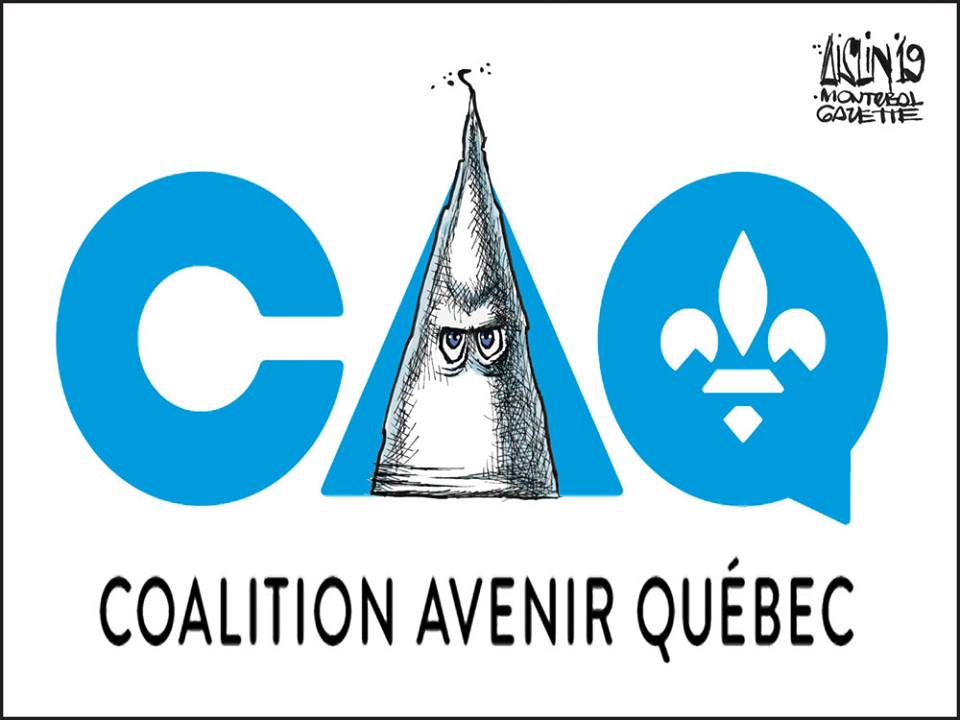
Aislin cartoon
Click to enlarge
Source: Facebook page of cartoonist Aislin

Only hours after putting the above blog on line, I received some news that illustrates all too graphically my point, in item 3 above, about slandering the CAQ by falsing associating it with the far-right. The cartoonist of the Montreal Gazette produced the caricature on the left. It is available on-line, on the cartoonist’s Facebook page. This image does not merely transmit a message which defames the CAQ. It is a major slur directed at all those who support the CAQ’s secularism measures, including the majority of Québécois. Although the Gazette decided not to run it—a wise decision, I think—I am publishing it here because it needs to be seen in order to expose the profound and virulent hatred for Québécois which underlies opposition to the CAQ’s very reasonable and laudable plans. This is the face of anti-Québécois racism, so prevalent in English-speaking Canada.


Next blog: An Open Letter to the Council of Canadians

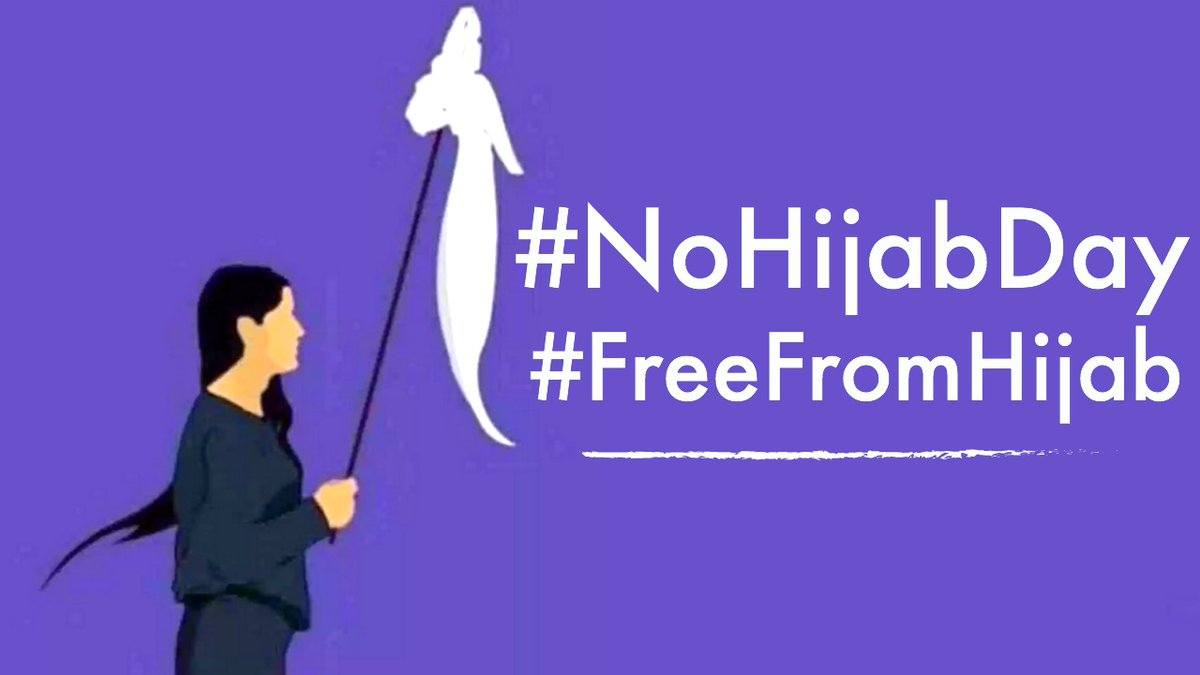
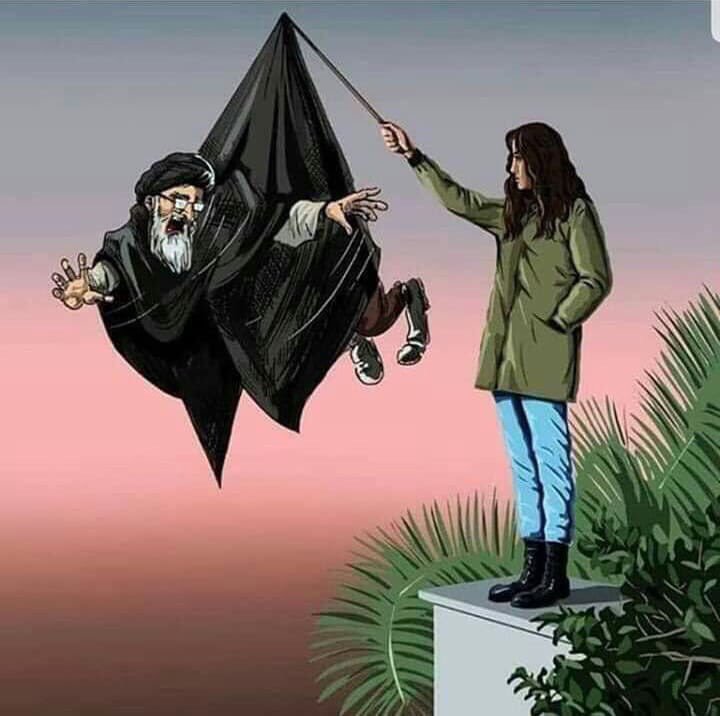
Support #NoHijabDay #FreeFromHijab

Support #NoHijabDay #FreeFromHijab! 1st February 2019 Solidarity with Iranian and Saudi Women.

Post a photo of yourself, on social media, with a headscarf hanging from a stick.

Appuyons #NoHijabDay #FreeFromHijab ! 1er février 2019 Solidarité avec les Iraniennes et Saoudiennes.

Poster une photo de vous, sur les réseaux sociaux, avec un foulard suspendu à un bâton.

#NoHijabDay #FreeFromHijabClick to enlarge

#NoHijabDay #FreeFromHijabClick to enlarge


“World Hijab Day” is soft-core propaganda for Islamism. Do not be duped. The hijab is an ambulatory prison for women.

La « Journée du hidjab », c’est la version légère de la propagande islamiste. Ne soyons pas dupes. Le hijab est une prison ambulatoire pour la femme.


Next blog: Three Strategies of Islamists

Canada’s Anti-Blasphemy Law Repealed, But M-103 Remains

2018-12-13

Canada’s anti-blasphemy law has finally been repealed. Excellent news. However, Motion M-103 which condemns “Islamophobia” remains in force.
Sommaire en français La loi canadienne qui criminalise le blasphème est enfin abrogée. Excellente nouvelle ! Toutfois, la Motion M-103 qui condamne l’« islamophobie » demeure en vigueur.
The Canadian Senate has voted to repeal the country’s “blasphemous libel” law (Section 296 of the Criminal Code), as part of a Bill C-51 which removes outdated legislation. Earlier today (2018-12-13) the senate announced on its twitter feed that the Bill has received Royal Assent and is thus adopted. This has excellent news indeed and has been reported on a number of atheist and humanist web sites such as End Blasphemy Laws and The Friendly Atheist. However, before breaking out the champagne, consider this. The various reports I have seen so far fail to mention an important problem: Motion M-103 remains on the books. That Motion condemns so-called “Islamophobia” and thus sets the stage for a new kind of anti-blasphemy legislation, condemning criticism of one religion, but without explicit use of the word “blasphemy.” Although Motion M-103 does not have force of law, it is dangerous for exactly the same reason as Section 296: its international impact. Both Section 296 and Motion M-103 give countries with similar legislation a convenient excuse to continue violating human rights by pointing to Canada’s bad example. Section 296 did not, of course, have force of law outside Canada either, and even inside Canada it had not been used for decades. Nevertheless, the symbolic effect was negative. Motion M-103 continues to provide that negative example. Furthermore, Motion M-103 is, in one sense, even worse that Section 296 in that it privileges one specific religion, giving it preferential treatment. So in addition to constituting a form of soft censorship of criticism of Islam, it will generate animosity from believers in other religions which are not so privileged. Moreover, there is a legitimate fear that in future M-103 may be followed eventually by a similar proposal, inspired by it, but having force of law.
Such accusations have precisely the same chilling effect as Motion M-103: they are a form of intimidation which stifles criticism of Islam and helps to further the agenda of political Islam.
This problem is complicated by the fact that some of the very people who applaud the repeal of Section 296 and claim to be secularists hypocritically support M-103. Even worse, some even repeat absurd accusations that to oppose M-103 is necessarily a right-wing or far-right position. Such accusations have precisely the same chilling effect as Motion M-103: they are a form of intimidation which stifles criticism of Islam and helps to further the agenda of political Islam. Secularists must now work to repeal Motion M-103 and to prevent the Canadian parliament from adopting in the future any motion or legislation similar or worse.

Next blog: Open Letter to TheConversation: An Organ of Anti-Quebec Propaganda

David Silverman’s Firebrand Atheism

We Need It Now More Than Ever

2018-04-23, minor changes 2018-04-24

A consideration of three major issues raised by David Silverman: the utter baselessness of god-belief, the importance of calling oneself an “atheist” and Silverman’s rejection of Jewish identity.

Sommaire en français Je considère trois questions importantes soulevées par David Silverman : l’absence totale de fondement pour la croyance en dieu(x), l’importance de se dire ouvertement athée et son rejet de l’identité juive.

I first envisaged writing this blog several weeks ago, before I heard about David Silverman being temporarily suspended and then definitively terminated from his position as president of American Atheists. I see no reason not to go ahead and write it, but I feel compelled at least to mention those somber recent developments. David claims to be innocent and, frankly, I see no reason to doubt him. In addition to the well established principle of assuming innocence until proven guilty, I have at least two reasons: (1) the vagueness of the charges I have heard so far; and (2) the fact that the current socio-political context is replete with examples of false or exaggerated accusations of various kinds.

Of course some accusations are true, but which ones? In some cases (such as Wienstein or Cosby), evidence is overwhelming and undeniable, but that is often not so. Indeed, it is because of all the dubious accusations poisoning current political discourse that it has become more difficult to distinguish reality from fanatically invented fiction. It has become commonplace for accusers to throw all nuance out the window, so that criticism becomes demonization and the work of the accused person is anathematized. I reject such puritanical excesses.

Until I see some solid evidence, I will withhold my judgement. Now to the topic at hand.


Recently I had the pleasure of hearing David Silverman deliver a powerful speech on the subject of his trademark “firebrand atheism.” It was in Warsaw, in a small theatre-like hall in the Polish Academy of Sciences, during a session, entitled “We, The Atheists,” of the Days of Atheism 2018. David’s delivery was forceful, even charismatic, and his subject perfectly appropriate to the occasion. As I wrote in a recent AFT blog about Days of Atheism 2018:

… the highlight of this series of talks was the rousing speech by David Silverman whose “firebrand atheism” is resolute and determined. He criticized and mocked the idea that there is any doubt whatsoever about the complete falsehood of god-belief. Furthermore, he emphasized the critical importance of identifying oneself by the term “atheist” rather than other wishy-washy and/or poorly understood epithets such as “humanist” or “freethinker.” Paraphrasing his message: “Because I am a true humanist, I call myself an atheist, not a humanist.” David’s highly effective and dynamic delivery and his unapologetic approach to atheism reminded us why he is Atheist of the Year 2018!

Later, in conversations over dinner during the convention banquet, we briefly discussed David’s attitude towards Judaism and his opinion that there is no such thing as a Jewish Atheist.

These three issues raised by David Silverman: the certainty of atheism, the importance of the “atheist” label and the futility of ethnicities such as “Jewish” all resonated with me strongly because they reflect ideas I have thought and written about myself. David’s perspective throws new light on these issues, while confirming and adding nuance to the conclusions I had already reached.

The Certainty of Atheism

First of all, we are not talking about absolute certainty, of the sort which exists only in abstract pure logic, or in the pretentions of religious dogma. I am talking about scientific certainty, or certainty beyond a reasonable doubt, where the probability of truth is extremely close to one. In the case of theistic religion, we should look at it from the opposite direction: what is the probability of the existence of any given god? Given that evidence is completely lacking, that probability is at most a number infinitesimally close to zero. Then, when we take account of the contradictions within each theism and the between competing theisms, that probability is reduced to zero. As David Silverman makes it clear in his talk, there is no room for doubt: “God” does not exist. In no other field, other than religion, would anyone even consider such a baseless hypothesis. It is time that we started applying to religion the same rigorous analysis which is normally applied in all other fields.

I have made this point in several writings in the past. For example, in Why We Are Not Agnostics, I criticize agnosticism because of its inherent a priori assumption of some non-negligeable probability of the existence of god(s). This error is especially serious in the case of what I call symmetric agnosticism which is based on the fallacy of the mean, assuming a probability of 50% from the get-go, without justification, something which even honest theologians would not dare to do. The doubt which is the basis of agnosticism is a method, not a final position. When that method of doubt is applied to any god-belief, the unavoidable conclusion is that belief is utterly baseless. Atheism is therefore a certainty until such time as theists come up with something to support their outrageous assertions.

The Importance of Calling Oneself “Atheist”

The very strong, very old and very well established prejudice against atheists, i.e. atheophobia, is an extreme form of religious bigotry. It is an essential aspect of theistic dogma, as each theism claims a monopoly on morals. Some atheists have concluded from this that we should avoid calling ourselves atheists publically. This is exactly the wrong approach; it is a recipe for hypocrisy and stagnation. We must boldy assert our atheism in order to oppose and weaken atheophobia. I have made this point in several writings, in particular in Atheophobia, An Ancient Prejudice, and Yet So Prevalent Today, where I define the term in some detail, and in Secular Atheophobia, where I discuss the problem of atheophobic attitudes even among the non-religious.

In his Warsaw talk in March 2018, David Silverman expressed it something like this: Being a true humanist, he calls himself an atheist rather than a humanist, because it is use of the label “atheist” which best challenges religous bigotry. Furthermore, says David, emphemisms such as “humanist,” and “freethinker,” etc. are poorly understood, or completely misunderstood, by the public, but everyone knows what an atheist is! I would express it thus: A humanist is just an closeted atheist, too cowardly to come out. The word “agnostic” is even worse, because it gives theism credit which it does not deserve. See the previous section of this blog!

Rejecting Jewishness

In an article in the online Tablet Magazine, Can You Be an Atheist and a Jew at the Same Time? David Silverman Says No., David Silverman’s views on Jewish identity are explained. He argues that Jewishness is ultimately a religion, only a religion, not a race or ethnic group. Once a person rejects the religion of Judaism, Silverman argues, that person is no longer a Jew. He asserts, “I am not a Jew. I am a child of Jews.” If one does not practice the religion Judaism, then one should abandon the Jewish identity.

I have expressed similar ideas, but from a different perspective. I would argue that if one continues to consider Jews as a so-called “race” or ethnic group, then it is important to distinguish that identity from the religion of Judaism. If that clear distinction is not made, if “race” and religion are conflated, then criticizing the religion becomes confused with antisemitic racism. Indeed, the importance of this distinction is a major problem with using the term “Islamophobia” as if it were a form of racism.

Indeed, this is precisely why Islamist ideologues promote the word “Islamophobia”: to conflate race and religion is exactly their goal, so that criticism of Islam can be dismissed as “racist.” Islamists want to create the same confusion between “Islam” and “Muslim” as already exists between “Judaism” and “Jewish”. What is needed, on the contrary, is to make the distinction clear. Jewish or Muslim identities have nothing to do with race because they are not immutable. A person’s religion is a choice, or at least should be. That is why the right to apostasy (to change one’s religion) is so important, and why the criminalization of apostasy in many Muslim-majority countries (punishable sometimes by death!) is such an egregious and dangerous violation of freedom of conscience.

Furthermore, David Silverman’s observation that a child of Jews is not necessarily a Jew is extremely important for the freedom of conscience of that child. Religion is not an inherited characteristic, it is a learned one. It is by a process of indoctrination that children end up in the same religion as their parents. This cycle must be broken by protecting children from such indoctrination. That is indeed is one of the purposes of universal public education. We must avoid such tendentious expressions as “Jewish child” or “Christian child” or “Muslim child” or even “atheist child.” Children must not be labelled by the choices of their parents. It is only when they reach maturity that they can make informed choices for themselves.

Rejecting Communitarianism

One final observation: the label “atheist” must not be allowed to degenerate into an identitarian label as if it were a religious affiliation. The purpose of calling oneself an atheist is to challenge and erode atheophobic attitudes promoted by various religions. It is not an expression of affiliation with a particular community. Atheism is not another religion competing with Christianity, Islam, etc. Rather, it is a rejection of unsubstantiated and dangerous supernatural beliefs, in particular god-beliefs. If one day in the future all theisms have disappeared, then atheism will no longer be necessary.


Next blog: Fairweather Secularists

Pride & Shame in Toronto & London

Islamophilia Infests LGBT Pride Marches

2017-07-20, updated 2017-07-22

A report of how pro-Islamist groups have attempted to censor criticism of Islamic homophobia at two recent LGBT pride marches.

Sommaire en français Comment plusieurs groupes pro-Islamist ont essayé de faire taire la critique de l’homophobie islamique lors de deux récents défilés de la fierté LGBT.

Recently two pride marches — in Toronto, Ontario, Canada and in London, England — have been marred by attempts to censor legitimate criticism of Islam, Islamism and Islamic homophobia.

Toronto

At the Toronto event on June 25th, a contingent of Iranian gays and other sexual minorities marched to protest the extreme homophobia of the brutal regime which rules their home country. However, they were almost prevented from doing so by a group of so-called “anti-fascists” as can be seen in the video Leftists call Muslim refugees islamophobic at Toronto Pride. I am not sure what group it was, as Antifa Toronto claims that they were not involved. At any rate, as Maryam Namazie reports:

[…] some ‘anti-fascists’ surrounded Iranian refugees and LGBTQ activists and absurdly chanted ‘No Hate at Pride’ – as if defending LGBTQ people in Iran or countries under Islamic rule is ‘hateful’.

Police intervention ensured that they weren’t able to stop the Iranians from joining Pride as the video below shows.

The irony of “anti-fascist” activists accusing an Iranian holding a sign saying “I am Muslim and condemn the persecution of LGBTQ+ in Islamic countries” of “Islamophobia” was clearly lost on them. It’s just another example of how criticism of Islamism or even Islam is conflated with bigotry against Muslims at the expense of dissenters and to the advantage of Islamists.

Source: In Toronto LGBT Iranians were branded as ‘Islamophobes’

This incident is yet another clear example, as if one were needed, of how use of the censorious accusation of “Islamophobia” enables Islamofascism by making it even more difficult to criticize the excesses of political Islam and Islamist theocracies. In particular this harms the people who are already in a difficult position: gays, other sexual minorities, apostates, etc. who are persecuted by Islam.

Last year (2016) Toronto Pride was disrupted by the organization Black Lives Matter (BLM) protesting the presence of police in the march. BLM activists were successful in forcing Pride organizers to ban police participation, so this year a contingent of Toronto police went all the way to New York City to march in their gay pride parade!

When I was very actively involved in the gay movement back in the 1970s (we quaintly called it “Gay Liberation” in those days), even the thought of police actually participating in our march would have been preposterous. The police were there on duty, only for basic security and control, certainly not as participants. Relations between gays and the police were very strained indeed because the police were often very homophobic and barely tolerated our existence. But times have changed greatly since then.

The 2016 incident with BLM may appear unrelated to this year’s attempt to block Iranian refugees and LGBTQ activists. But the two incidents are indeed related. (1) Firstly, if one consults the list of demands on the web site of BLM-Toronto, we see that the demand “END ISLAMOPHOBIA & WHITE SUPREMACY” features prominently. That statement is extremely problematic for two reasons: it declares “Islamophobia” to be something one should fight against, which is nonsense, because there is nothing irrational or objectionable about fearing a dangerous religion such as Islam (or Christianity, or several others). Even worse, the statement lumps “white supremacy” — which indeed is a very dangerous and reprehensible form of racism — in with it. Such an inconsistent and ridiculous demand shows that whoever prepared the list is not even clear about what racism is, because a religion has nothing to do with race. How can we support an ostensibly anti-racist organization which is so evidently incompetent? (2) Secondly, Toronto police were involved in both incidents.

When so-called “anti-racist” and “anti-fascist” groups take actions which are more regressive than those of the police, then it is time for the leaders and members of those groups to undertake some serious reflection.

In both incidents, a group denouncing “Islamophobia” and thus showing its affinity with the regressive pro-Islamist “left” disrupted or attempted to disrupt the event. In both incidents, Toronto police took a position which was ironically more progressive than that of either BLM or the “antifas.” In the first incident police wanted to march for gay rights but were prevented. In the second they intervened and allowed the Iranians to march for gay rights. When so-called “anti-racist” and “anti-fascist” groups take actions which are more regressive than those of the police, then it is time for the leaders and members of those groups to undertake some serious reflection.

London

Meanwhile, across the pond in London, events transpired which somewhat resembled those in Toronto two weeks earlier. The group Council of Ex-Muslims of Britain marched in the July 8th Pride parade carrying banners with slogans such as “ALLAH IS GAY,” “FUCK ISLAMIC HOMOPHOBIA,” and my personal favourite “WE’RE HERE, WE’RE KAFFIR, GET USED TO IT.” (The term “kaffir” or “kafir” means a non-Muslim or an apostate of Islam.) It was a great success, as can be seen in the video The Council of Ex-Muslims of Britain (CEMB) participates in Pride and in the report on the CEMB web site. CEMB’s participation was not blocked, although “police initially tried to remove placards with the slogan ‘Allah is Gay’ because of complaints of ‘offence’.”

More negative reactions came quickly in the aftermath of the march. The East London Mosque was so upset that it filed a formal complaint with Pride festival organizers. They of course denounced CEMB’s participation as “Islamophobic” and they criticized placards naming the Mosque as promoting homophobia. And they were particularly irate about the “ALLAH IS GAY” slogan.

Now, the slogan “Allah is gay” is of course meaningless, because Allah is a fictional character. It is like saying, “Superman likes blueberries” or “Thor is left-handed.” Nevertheless, it is a very useful slogan because it exposes homophobia. Indeed, the very fact that the East London Mosque was so offended by it means that they are homophobic, because they consider that calling their god gay is shameful. But in reality, it is the other way around. It is insulting to gays to be associated with such a distasteful character as Allah. But we know he is fictional, so we are not offended. And even if he were real, that would not justify censorship of the slogan.

The mosque accused CEMB of inciting hatred of Muslims, which of course they were not at all doing. CEMB was simply denouncing homophobia — and sometimes very violent and even deadly homophobia — based on Islam and enforced by theocratic regimes. As Maryam Namazie, speaking for CEMB in an email, declared:

the very reason CEMB was at Pride was to combat hate and to highlight the 13 states under Islamic rule that kill gay men (14 if we include Daesh-held territories). We included placards on the East London mosque to bring attention to the fact that there are mosques here in Britain that promote the death penalty for homosexuality and apostasy.

As ex-Muslims, we are at risk from hate preachers that speak at some mosques and universities; our gay members are at an increased risk.

The East London Mosque has a long history of hosting hate preachers who incite against blasphemers, apostates and homosexuals so we felt naming and shaming them was very apt.

Unfortunately, Pride organizers have so far reacted badly, denouncing CEMB. In the words of a spokesperson:

“All volunteers, staff and parade groups agree that Pride celebrates diversity and will not tolerate any discrimination of any kind. While our parade has always been a home to protest, which often means conflicting points of view, Pride must always be a movement of acceptance, diversity and unity. We will not tolerate Islamophobia.”

Evidently, the organizers do not accept a diversity of opinion and have bought into the dishonest propaganda of those who use accusations of “Islamophobia” as a form of bullying to silence legitimate criticism of Islamic ideology.

But CEMB has fought back rapidly, declaring that ‘They are trying to silence us’. Speaking for CEMB, Maryam Namazie said:

“Why are signs critical of Islam (a belief) and Islamism (a far-right political movement) ‘anti-Muslim’?” Muslims are people, with as many different opinions as anyone else. They are not a homogeneous group but individuals. Some will agree with us, others won’t. In fact, several Muslims visiting from Bangladesh joined us. The incredible support we received from minorities in the crowd cheering us on is a reflection of that. Not everyone was offended. And offence can never be a reason to censor and silence dissent.”

“[…] the climate we live in where bullies and homophobes are rewarded and victims blamed.”

As for the East London Mosque:

“The fact that […] their complaint is taken seriously by Pride speaks volumes about the climate we live in where bullies and homophobes are rewarded and victims blamed. The real problem for them is that we are ex-Muslims. We are not allowed to speak or show ourselves or challenge views that degrade and denigrate us.”

Apostasy is a Human Right!

Bravo to the Council of Ex-Muslims of Britain and to Iranian and other Muslim refugees who support LGBT rights! And shame on all those who attempt to silence criticism of Islam or Islamism! Freedom for Muslim gays and other sexual minorities and freedom for ex-Muslims whose only “crime” is to exercise their freedom of conscience!


Next blog: Quebec’s Right to Self-Determination

“Islamophobia”: a weapon against reforming Islam

2017-04-20

This blog consists of quotes from Hassan Jamali, as published in the book L’ISLAMOPHOBIE

Sommaire en français Ce blogue se compose de citations de Hassan Jamali tirées de l’ouvrage collectif L’ISLAMOPHOBIE.

This blog is dedicated entirely to quotes from Hassan Jamali, co-author of the recent book L’ISLAMOPHOBIE published by Éditions Dialogue Nord-Sud. This is a collective work, authored by Jérôme Blanchet-Gravel, Éric Debroise, Caroline Fourest, Hassan Jamali, Isabelle Kersimon, Renard Léveillé, Fiametta Venner, Claude Simard, Annie-Ève Collin and Alban Ketelbuters, with a preface by Waleed Al-husseini.

Book L'ISLAMOPHOBIE
Book L’ISLAMOPHOBIE

This little book is an essential reference, required reading in order to understand the concept—or rather the scam—of so-called “Islamophobia” which is a major propaganda weapon used to promote Islamofascism and to bully those who oppose it.

Hassan Jamali teaches at a Montreal CÉGEP and is author of the book Coran et déviation politique. L’art de détourner une religion. (The Koran and Political Distortion. How to Hijack a Religion., Éditas 2011).

In the collective work L’ISLAMOPHOBIE, Hassan Jamali is author of the chapter entitled “Islamophobie: une arme pour contrer toute réforme de l’islam” or “Islamophobia: a weapon against reforming Islam.” Below I have translated some important excerpts from that chapter.


We consider that reforming Islam is a major issue, both for a billion Muslims and for the Western world. Islamism, as a fascistic political ideology, threatens the foundations of democratic systems, just as did all the totalitarian ideologies which the West experienced during the twentieth century. And the fact that that ideology is inspired by a great religious tradition does not make it any more tolerable.

[…]

The only purpose of the concept of Islamophobia is to restrict freedom of expression and to frighten those who defend secularism and who dare to take a position against religious accommodations. Proponents of victimization based on Islamophobia have increased their activities in the West (including Quebec) and even within the United Nations, with the goal of gaining approval for laws and resolutions which would ban blasphemy and anti-religious hate speech.

Public institutions in Quebec have fallen into this trap. Islamophobia is used in official documents published by the Ministry of Immigration, Diversity and Inclusion in order to explain the elevated unemployment rate among those of North-African origin. The City of Montreal uses it as well. The Bouchard-Taylor Commission, in its report, also refers to Islamophobia, while nevertheless failing to mention it in its glossary.

[…]

How Should We Respond to Blackmail by Islamophobia?

We have observed that no substantial reform of Islam is possible in Muslim countries because of the stranglehold which the religious have on political power. The real battle is therefore to be fought in the West. Two sides are battling it out: in the Sunni camp, the Islamists are supported and financed by Saudi Arabia and Qatar, while, in the Shiite camp, they are backed by Iran and the Lebanese Hezbollah.

The goal of the Islamists is to isolate Muslims, to prevent then from adopting democratic and secular values and to use them against any criticism of Islam. Islamophobia is the slogan par excellence, which they use to bully all those who would criticize Islamic dogma, thus ghettoizing Muslims—and in particular Muslim women, on whom is imposed the task of signaling the presence of Islam in public space—all in a spirit of communitarianism which alienates the host society.

How to respond to this state of affairs is not a simple question, especially with political correctness and religious accommodation being so widespread. But by refusing to endorse the notion of Islamophobia and by insisting on freedom of expression as well as state secularism, we can affirm our rejection of all intimidation and continue to fight against the rebirth of fascism in the form of Islamism.

Next blog: Notes on the Islamist Veil